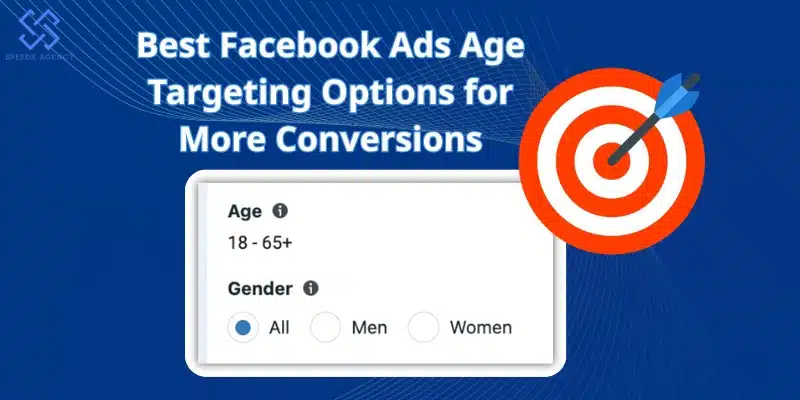
Facebook Ads offers several age targeting options, including Audience Controls, Audience Suggestions, and Manual Targeting. However, not every age range delivers the same results across all industries or business objectives. Understanding Facebook Ads Age Targeting Options can help you select the most appropriate age range, reduce wasted ad spend, and improve conversion rates.
Facebook Ads Age Targeting Options Available in 2026
Facebook Ads targeting in 2026 is significantly different from the era when marketers relied heavily on Detailed Targeting with countless interest and behavior options. Instead of overly granular targeting, Meta now prioritizes data-driven approaches, artificial intelligence, and the platform’s automated optimization capabilities.
Today, most successful Facebook advertising campaigns operate through the following three common targeting mechanisms.
1. Audience Controls (Hard Constraints)
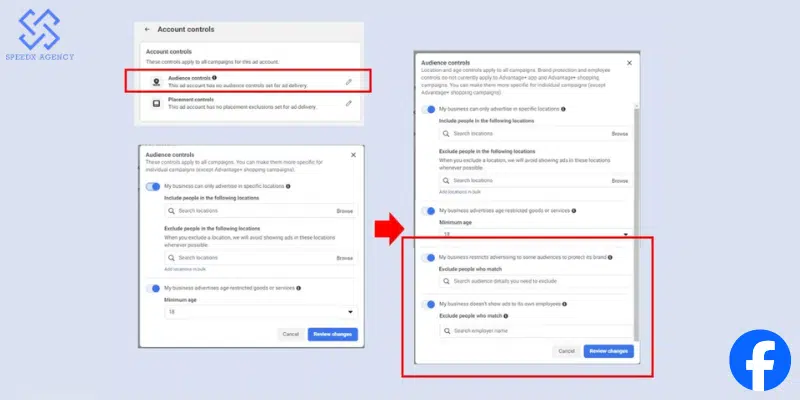
In simple terms, Audience Controls are the only protection layer that Meta guarantees to enforce strictly within the Advantage+ environment.
With Meta’s Advantage+ Audience, which is now the default audience system for Sales, Traffic, and Conversion campaigns, most audience inputs are treated as soft suggestions. However, the platform still enforces strict guardrails that its AI cannot override, including minimum age restrictions.
You can set a fixed minimum age anywhere between 18 and 25. For example, if you set the minimum age at 21, Meta’s algorithm will be completely prevented from delivering ads to anyone under 21, regardless of how likely they are to convert.
This perspective is also supported by Jon Loomer, one of the most respected Meta Ads experts in the industry. In his analysis of Advantage+ Audience, he emphasized that:
“Audience Controls are tight constraints that Meta must follow.”
Based on more than seven years of hands-on experience managing Meta Ads campaigns, I generally do not recommend using these restrictions as a primary targeting strategy. Instead, I only apply Audience Controls when legal requirements or product-specific regulations make them necessary, such as in alcohol, financial services, or other industries with age-related restrictions and eligibility requirements.
You can refer to Meta’s age-targeting policies and industry-specific restrictions for additional guidance.
2. Audience Suggestions (Soft Signals)
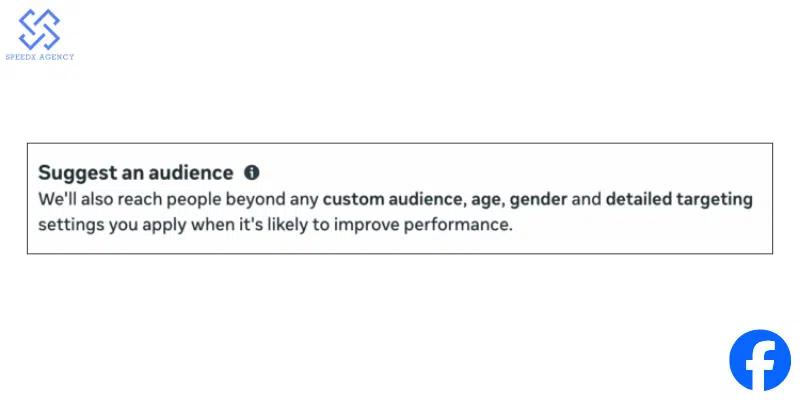
For most standard business campaigns that use Advantage+ Audience and are not subject to targeting restrictions, age selection primarily serves as a starting point rather than a hard boundary.
You can provide the demographic range that best represents your ideal customer. Meta’s system uses this information as an initial signal to guide delivery during the learning phase. However, if the algorithm discovers higher-quality conversions or lower-cost opportunities from users outside the suggested age range, it can automatically expand beyond those recommendations to maximize performance.
Meta has publicly stated that its system prioritizes people who match your suggested audience profile before broadening its search. This includes factors such as age, gender, interests, and behaviors.
Meta also confirms that when using Advantage+ Audience, the platform may “look outside your set targeting parameters” to find people who are more likely to convert.
Throughout 2026, Meta’s AI will continue combining audience inputs with predicted user behaviors. Therefore, my recommendation for advertisers is to prepare for a more automated advertising environment by focusing on signal quality rather than attempting to control every demographic variable.
3. Manual Targeting (Using Original Audience Options)
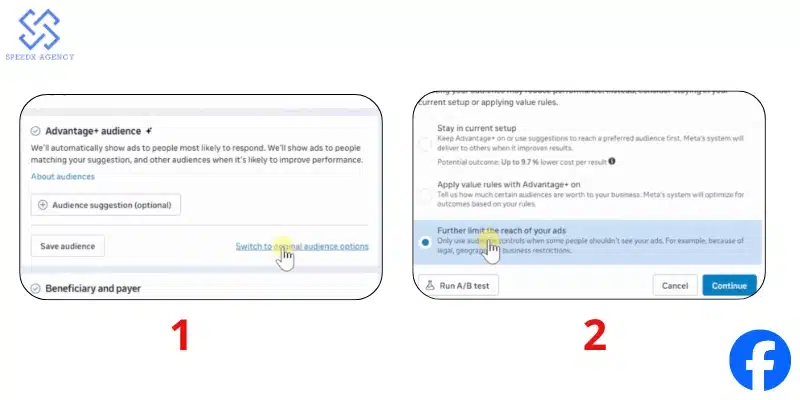
According to Meta’s official documentation, advertisers can switch from Advantage+ Audience to Original Audience Options whenever stricter targeting criteria are required.
Meta explains that Advantage+ Audience is designed to automatically expand reach and maximize campaign performance, whereas Original Audience allows advertisers to define specific demographic criteria such as age, gender, and location.
Meta also confirms that the maximum age setting available within Ads Manager is 65+, allowing businesses to maintain precise control over their preferred age ranges instead of allowing automatic expansion.
Source: https://www.facebook.com/help/157306091096340
This is an option that I highly value when running campaigns that require clean testing data, products designed for a specific age group, or situations where minimizing irrelevant traffic is a priority.
I also recommend using this approach during the early stages of a campaign to clearly identify which age segments respond most positively to your ads. Once sufficient data has been collected and high-performing audiences have been identified, you can gradually broaden your targeting or transition to Advantage+ Audience to leverage Meta’s optimization capabilities while maintaining conversion efficiency.
Read more: A-Z Guide On How To Target Facebook Ads By Email Address
Best Age Targeting Strategies for Different Industries

There is no universal “perfect” age range that works for every industry.
Consumer behavior, purchasing power, product demand, and conversion intent vary significantly across different markets. After years of managing Facebook Ads campaigns for a wide variety of business models, I have found that each industry requires its own age-targeting strategy to maximize advertising performance and return on investment.
Below are the age ranges I typically prioritize when testing and optimizing campaigns.
E-commerce
For e-commerce businesses, the most effective age group is often between 25 and 44 years old, as these consumers tend to shop online more frequently and have greater purchasing power.
However, instead of applying strict limitations immediately, I generally recommend using Advantage+ Audience with an age suggestion of 25–44, allowing Meta to expand beyond that range when better conversion opportunities are identified.
Beauty & Cosmetics
The beauty industry typically serves a broad audience, including both men and women, especially for skincare and anti-aging products.
- Beauty products for younger consumers: 18–30
- Premium skincare products: 25–45
- Anti-aging products: 35–55
In practice, I usually allow Meta to optimize freely during the initial phase before analyzing age-based performance data to identify the segments generating the highest ROAS.
Education & Online Courses
Age targeting for online education depends heavily on the course topic.
- Student skill-development courses: 18–24
- Career-focused training programs: 25–40
- Leadership and management training: 30–55
Based on campaign performance, the 25–40 age group frequently generates the highest registration and payment completion rates.
Real Estate
Real estate is one of the industries where age can significantly impact lead quality.
People under 25 often have limited purchasing intent or financial capability to buy property. As a result, many advertisers choose to exclude this age group entirely.
- Residential housing: 28–55
- Luxury apartments: 30–60
- Real estate investment: 35–65+
This is one of the few industries where I frequently consider using Original Audience targeting for tighter age control.
Finance & Insurance
Financial products typically require customers to have stable income and long-term financial planning needs.
- Credit cards: 25–45
- Life insurance: 30–55
- Investment services: 28–60
In many financial campaigns, excluding very young audiences can significantly reduce the cost of unqualified leads.
B2B Services
B2B audiences are typically business owners, managers, or decision-makers within organizations. Their average age is often considerably higher than that of typical B2C audiences.
- Small business owners: 30–55
- Executives and business leaders: 35–65+
- Mid-level managers: 28–50
For B2B campaigns, I generally prioritize lead quality over reach and often start with audiences aged 30 and above.
The age range I most commonly recommend is:
30–60 years old.
Frequently Asked Questions About Facebook Ads Age Targeting Options
What Is the Minimum Age You Can Target on Facebook Ads?
In most countries, Facebook Ads allows advertisers to target users aged 18 and above. However, the minimum eligible age may vary depending on local laws and regulations.
When setting up a campaign, you should always verify the available age range within Ads Manager to ensure compliance with Meta’s current policies.
Can I Target Users Over 65 Years Old?
Yes.
Facebook allows advertisers to target users aged 65 and above using the “65+” option in Ads Manager.
This targeting option is particularly useful for products and services aimed at older consumers, including healthcare services, insurance products, retirement travel packages, and senior support programs.
Should I Create Separate Ad Sets for Different Age Groups?
The answer depends on your campaign goals and budget.
If you want to analyze performance by age segment or test audience behavior hypotheses, creating separate ad sets can provide clearer data insights.
However, if your budget is limited, splitting campaigns into too many ad sets may reduce Meta’s ability to optimize effectively due to smaller data volumes.
Conclusion
Facebook Ads Age Targeting Options remain a powerful tool for reaching the right audience and improving campaign performance. However, as Meta’s algorithm becomes increasingly data-driven, successful advertisers rely on testing and real conversion data rather than assumptions when making targeting decisions.
The right age targeting can improve results, but the right ad account can help you scale those results further. If you’re looking for a stable and reliable Facebook Agency Ad Account, SpeedX Agency can help you launch, optimize, and grow your campaigns with confidence.
Trust data, keep testing, and focus on long-term performance.