Imagine you’re a Facebook advertiser looking to increase your conversion rate.
What would you do?
A. Run ads during the commonly shared “best times” you find online, such as 9 AM or 8 PM.
B. Analyze your own customer data and identify the time periods that generate the highest number of conversions.
If you chose B, you’re approaching the problem the same way most Meta advertising experts recommend.
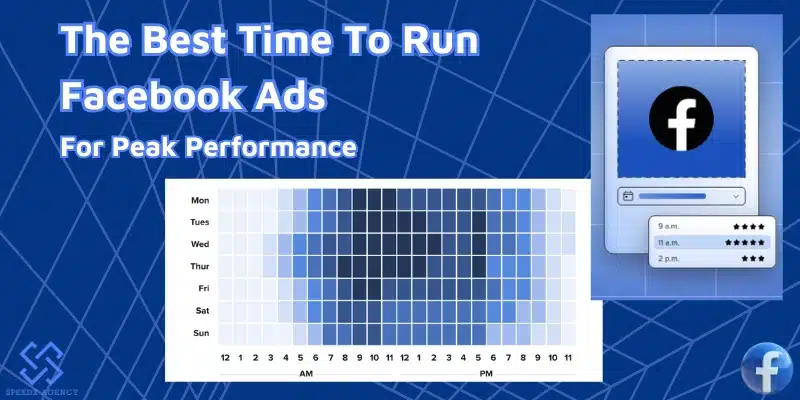
Many advertisers believe there is a universal “golden hour” for running Facebook Ads. However, the reality is that Meta now uses a machine-learning-based ad delivery system that automatically finds users who are most likely to convert throughout the day. As a result, restricting your ads to a fixed time slot does not necessarily lead to better performance.
With 11 years of experience and exposure to a wide range of industries—including home goods, beauty products, dietary supplements, and more—I can confidently tell you that there is no single, fixed answer to the best time to run Facebook ads. The most effective advertising hours depend on your target audience and the industry you operate in.
How to Find the Best Time to Run Facebook Ads
To determine the best time to run Facebook ads, you need to understand the following factors:
Understand Your Industry
Different industries have different advertising “golden hours.”
For example, if you operate in the food and beverage industry—such as restaurants, coffee shops, or food delivery services—your ads often perform better during periods close to mealtimes, such as 10:30 AM–1:00 PM and 5:00 PM–8:00 PM. During these hours, consumers are more likely to search for places to eat or order food online.
In contrast, for B2B industries such as enterprise software, marketing services, or business consulting, potential customers are generally more active during regular business hours, typically between 8:00 AM and 5:00 PM on weekdays. Running ads during these periods allows you to reach decision-makers when they are working and actively looking for solutions to business challenges.
Another example is the fashion and beauty industry. Many advertisers report significantly higher engagement and conversion rates during the evening hours, particularly between 7:00 PM and 10:00 PM, when users have more free time to browse Facebook, watch live streams, and shop online after work.
Know your target audience
Get to know your target audience demographics and their lifestyle. With around 2.9 billion monthly active users, Facebook is the most popular social media worldwide (reference from Statista). However, this large number of users are not always active. They’re more likely to use Facebook during certain times and engage in content that aligns with their current interests.
Example 1:
A business professional may be active during business hours or early morning/evening when they are commuting. Meanwhile, a new parent may be scrolling Facebook during newborn’s nap times or before bed.

Example 2:
Most people are employees, thus, according to Muhammad Arham, a Meta Ads Manager at Techbunk, the best days to run ads on Facebook or any platform to educate your target audience is from date 20 – 30 of the month. Then from the 1st date of the month, when they receive their salaries, you can advertise your sales campaign to them.
You can also analyze these general user behavior patterns:
- Early Birds: Those who often scroll their phones right after waking up. The best time to run Facebook ads in the morning to target them is from 6-9 AM.
- Lunchtime Lurkers: Those who use Facebook during lunch breaks. To target them, you can run ads from 11 AM-1 PM.
- Afternoon Attention: People focus on work and reduce time for Facebook. For these audiences, you shouldn’t waste money to run ads from 1-4 PM.
- Evening Escape: People turn to Facebook for entertainment and news after their day. The peak time to run ads to target them is from 5-9 PM.
Set Up A/B Testing

A/B testing is one of the most effective ways to identify the exact time periods that generate the best results for your business based on real performance data.
The process is straightforward. Create two or more ad sets with the same target audience, ad creative, budget, and bidding strategy. The only variable you change is the ad delivery schedule. After running the test for a sufficient period of time, compare key performance metrics such as CTR, CPC, CPA, and ROAS to determine which time slot delivers the strongest results.
Real-World Example
I was running Facebook Ads for a Digital Marketing training center with the goal of generating leads.
I created two ad sets:
Ad Set A
- Schedule: 8:00 AM – 12:00 PM
- Budget: $20/day
Ad Set B
- Schedule: 6:00 PM – 10:00 PM
- Budget: $20/day
After 14 days, the results were as follows:
| Metric | Ad Set A | Ad Set B |
|---|---|---|
| CTR | 1.3% | 2.0% |
| CPC | $1.85 | $1.22 |
| Leads | 41 | 68 |
| Cost Per Lead (CPL) | $6.83 | $4.12 |
The results showed that the evening campaign generated 66% more leads while reducing the cost per lead by nearly 40% compared to the morning campaign. The primary reason was that the target audience consisted mainly of small business owners and managers who typically spend time researching software solutions after work.
Similarly, you can run A/B tests to compare:
- Monday vs. Friday
- Weekdays vs. weekends
- Morning vs. evening
- Beginning of the month vs. end of the month
- Off-season vs. peak season
Consider Time Zones
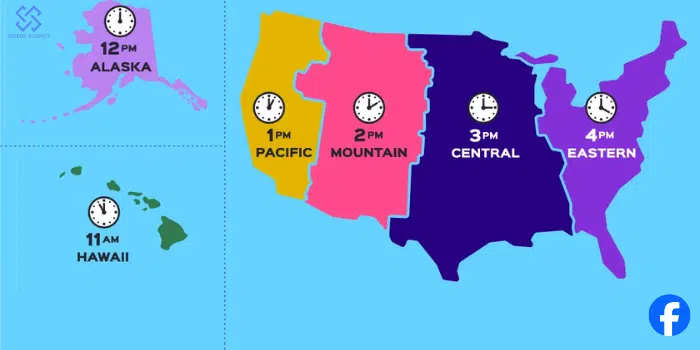
While managing Facebook Ads for international businesses, I have noticed that many advertisers focus heavily on audience targeting, creative optimization, and budget allocation while overlooking one critical factor: time zones.
This mistake can significantly reduce campaign performance.
If your customers are spread across multiple countries, displaying ads when they are asleep or less active on social media can dramatically reduce reach, engagement, and conversions. On the other hand, showing ads during the hours when users are most active often leads to higher click-through rates, stronger conversion rates, and more efficient budget utilization.
For example, I once managed a campaign for a company based in Vietnam whose primary market was the United States. Initially, the campaign was launched at 9:00 AM Vietnam time, which corresponded to approximately 10:00 PM the previous day in New York.
During the first three days, the campaign achieved a CTR of only 0.92%, while the cost per lead remained relatively high.
The campaign schedule was then adjusted to align with the local time zone of U.S. customers, focusing on two key windows: 8:00–11:00 AM and 6:00–9:00 PM New York time.
After two weeks of testing, CTR increased to 1.47%, while CPL dropped by approximately 24%.
This demonstrates that even when the audience, budget, and creative remain unchanged, simply adjusting the ad schedule can produce dramatically different results.
Google Ads follows the same principle. According to Google’s official documentation:
“Ad schedules are set based on your account’s time zone, so you should adjust your ad schedule to account for any difference in your target customers’ time zone.”
The same logic applies to Facebook Ads. When ad delivery is aligned with the hours when users in each geographic market are most active, advertising budgets are used more efficiently instead of being spent during periods of low demand.
Consider Holidays and Seasonal Trends
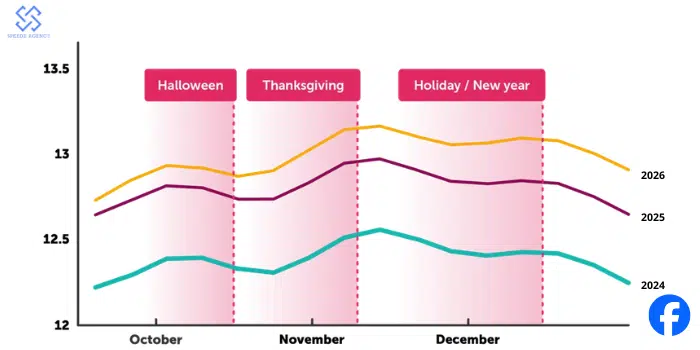
One of the most common mistakes I see businesses make is optimizing Facebook Ads based solely on short-term data while ignoring seasonality.
In reality, consumer buying behavior changes significantly throughout the year. A campaign that delivers a high ROAS in November may perform very differently in January, even if the audience, budget, and ad creatives remain exactly the same.
That is why identifying the best time to run Facebook Ads requires looking beyond the hour of the day or the day of the week. You must also evaluate seasonal peaks and major holiday shopping periods.
For ecommerce businesses, the period from October through December is often the most lucrative shopping season of the year due to events such as Black Friday, Cyber Monday, Christmas, and New Year’s promotions.
Based on my experience, CPMs during Q4 frequently increase by 20%–50%, and in some cases by as much as 80% during Black Friday week due to intense advertiser competition.
However, purchase intent typically rises at the same time, which often leads to higher conversion rates and the strongest revenue performance of the year.
For example, I once managed campaigns for a personalized gift brand.
In September, the campaign achieved an average ROAS of 3.2.
During the year-end holiday shopping season, CPM increased by nearly 40%, yet ROAS climbed to 5.1 because of the substantial increase in gift-buying demand.
This example highlights an important lesson: higher advertising costs do not necessarily mean lower profitability when market demand is at its peak.
Conversely, consumer spending often declines significantly once the holiday season ends.
According to research on seasonal ROAS fluctuations in Meta Ads, many advertisers experience ROAS declines of between 20% and 40% during January and February compared to Q4 performance, as consumers have already completed much of their holiday shopping.
In addition, every market has its own unique seasonal events and holidays. For example:
Vietnam
- Lunar New Year (Tet)
- International Women’s Day (March 8)
- Vietnamese Women’s Day (October 20)
- Mid-Autumn Festival
- Back-to-School Season
United States
- Black Friday
- Cyber Monday
- Thanksgiving
- Valentine’s Day
Europe
- Easter
- Boxing Day
- Summer Sales
According to Google’s holiday shopping behavior research, as summarized by Business Insider, approximately 83% of consumers research products before making a purchase, and many shoppers begin planning their purchases several weeks before major holidays. This suggests that businesses should not wait until the holiday itself to start running ads. Instead, they should launch campaigns early to build brand awareness and stimulate purchase intent.
Based on my experience, I recommend creating a “seasonality map” for your business using data from the previous 12 months. Track key metrics such as CTR, CPC, CPM, CPA, and ROAS during different periods throughout the year. After one or two business cycles, you will be able to identify the exact time periods that generate the highest revenue for your business, rather than relying on generic advertising schedules that may not apply to your specific market.
How To Schedule Facebook Ads At The Best Time
Use Meta Business Suite

Meta Business Suite is free for any business, organization, or individual active on Facebook. It allows you to schedule ads in advance. It also helps you track and analyze the results to identify the best time for Facebook ads.
To start scheduling, you must have Facebook access to the page which is added to your business portfolio in Meta Business Suite, or have task access to ads. Then, you can follow those steps:
- Go to Meta Business Suite at https://business.facebook.com.
- Click on Ads from the menu bar, then click Create ad on the top right.
- Select a goal for your ad, or set up Automated ads/Boost Facebook content.
- Fill in the information asked for your ad: ad creative, special ad category, audience, budget, placements, customer info, payment, and privacy policy.
- Under Schedule and Duration, pick a Start date and Start time. To determine how long your ad runs, edit Days or choose an End date.

- To see your ad will look across different placements, click See all previews.
- Click Schedule to finish.
Use Ad Scheduling

Ad scheduling is only available when you set up a budget. To use Ad Scheduling, first go to Meta Ads Manager and click the ‘+Create’ green button.
Complete the setup steps as you would for a normal campaign. But stop at the Ad Set setup screen, and scroll down to the ‘Budget & schedule’ section. Here, you have two options for scheduling your ads:
Option 1: If you choose ‘Lifetime budget’, you can schedule your ads using the scheduler provided by Meta. It looks like this:

You can highlight the time sections of this table in dark blue. These are the times you can choose to have your ads automatically turn on and run.
Option 2: This option is available when you select ‘Daily budget’. It looks like this:

Basically, you can choose the start and end date (in the future) of your ad campaign. And your ads will only spend and run during the time period you choose. For example, some offline beverage businesses do not want to turn on ads on the first days of the week, so these two options give businesses the flexibility to do so.
Custom rules in Meta Ads Manager
Facebook Ad Custom Rules in Meta Ads Manager are a powerful tool that helps you schedule ads at the defined best time to run Facebook ads and optimize your campaign’s performance.
Custom Rules allow you to set up automated rules based on specific conditions you set. For example, you can create rules to:
- Turn ads on/off: Automatically turn ads on at times you’ve determined perform best and turn them off at other times.
- Adjust budgets: Increase or decrease ad budgets based on campaign performance or specific metrics like cost per result (CPA) or click-through rate (CTR).
- Send notifications: Get notifications when ads reach milestones or need your attention.
Here are steps to create a custom rule:

- Go to Meta Ads Manager at https://adsmanager.facebook.com/.
- Pick the ad sets or ads you want to apply the rule to.
- In the Rules dropdown menu, select Create a new rule.
- A new window appears, choose Custom rule, then select Next.
- Choose Rule name and ad sets or campaigns which you’d like to Apply rule to.
- Select Action to do when your ad or ad set meets the conditions.
- Set the Conditions of your rule, then click Add. Select + if you want to add more conditions.
- Active the type of Notification that you want to receive, it could be Meta notifications or email notifications.
- Add a Subscriber to receive notifications when your rule is triggered.
- Select Create to finish.
Epilogue
Hope that with these useful pieces of information, you can determine the best time to run Facebook Ads and gain optimal results for your business ad campaigns. To run effective Facebook Ads, it’s essential to continuously expand your advertising knowledge. We’ve compiled a wealth of information and insights on paid advertising in our Facebook Ads Blog. Feel free to click and explore our recent articles – they’re incredibly valuable. SpeedX Agency wishing you success with your Facebook Ads!